The two most common notarizations requested are acknowledgments and jurats. But not everyone knows the difference between these two acts. Here are some important points you should know.
What is an acknowledgment?
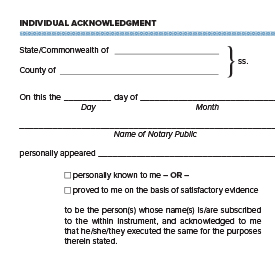
The purpose of an acknowledgment is for a signer, whose identity has been verified, to declare to a Notary or notarial officer that he or she has willingly signed a document.
 Click to expand.
An acknowledgment requires the following steps:
- The signer must appear in person before you.
- You must positively identify the signer according to your state’s rules.
- The signer may either sign the document before appearing before you, or in your presence. You may perform an acknowledgment if the document was signed prior to the signer appearing before you.
- The signer must declare (acknowledge) signing the document for its intended purpose.
In most states, the signer must be able to directly communicate with you that he or she willingly signed the document.
However, Arizona, Colorado and Mississippi permit a signer to communicate with a Notary through an interpreter who is personally appears at the notarization. Colorado prohibits using an interpreter who has a disqualifying interest, such as the interpreter or a relative of the interpreter being a party to the transaction being notarized, or receiving a beneficial or financial interest from the transaction.
What is a jurat?
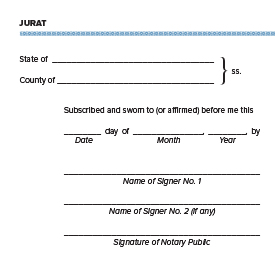
The purpose of a jurat — also known in some states as a “verification upon oath or affirmation” — is for a signer to swear to or affirm the truthfulness of the contents of a document to a Notary or notarial officer.
 Click to expand.
A jurat requires the following steps:
- The signer must appear in person before you and sign the document in your presence. You may not perform a jurat for a signature made before the signer appeared before you.
- In some states, you are required to positively identify the signer.
- You must administer a spoken oath or an affirmation, and the signer must respond out loud. Silent answers, such as a nod of the head, are not acceptable.
While not required by law, it is strongly recommended that you have the signer raise his or her right hand to emphasize the seriousness of the oath or affirmation.
A jurat cannot be executed by someone offering to take the oath in someone else’s name — the original signer must swear or affirm the oath in person before the Notary.
Acknowledgment and jurat certificates
Because acknowledgments and jurats are different notarizations with different purposes, each requires its own certificate wording. You cannot use a jurat certificate for an acknowledgment, or vice versa. Make sure you use certificate wording that complies with your state’s rules.
In general, an acknowledgment certificate will contain the words, “acknowledged before me” or similar wording. Jurat certificates will contain the words, “subscribed and sworn to (or affirmed) before me.”
If you have questions about the certificate wording, check your state’s Notary handbook or contact the NNA Hotline for help.
Related Articles:
Common Notary certificate issues explained